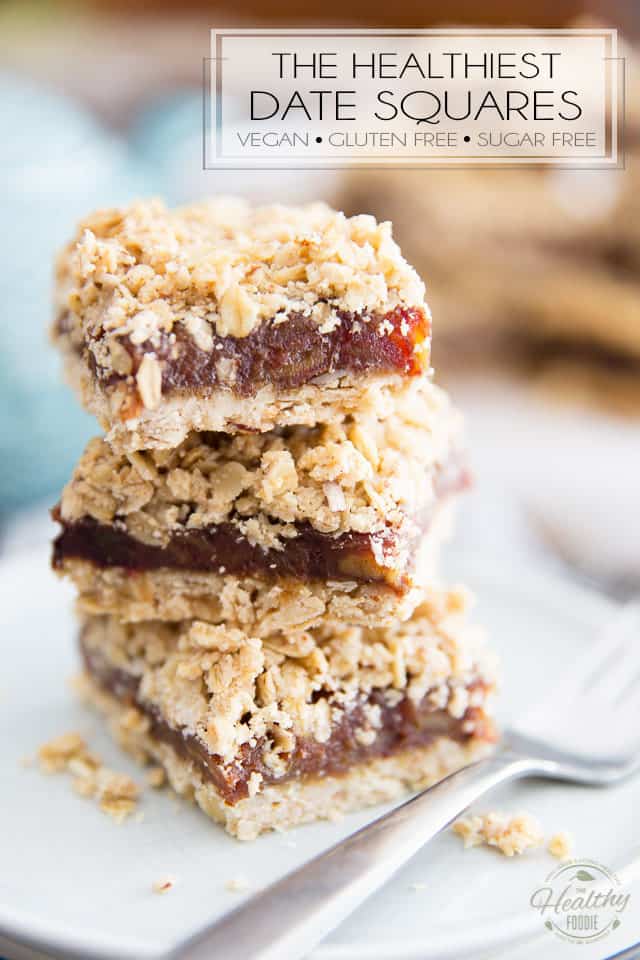
Free of gluten and added sugar, these Vegan Date Squares are just as good, if not better, than the real thing! Super moist and deliciously tasty, they’re the perfect replica of your typical soft, sweet and crunchy date square.
Date Squares are another Holiday staple in this household… I think it’s mainly due to the fact that they happen to be one of my son’s favorite treats. He doesn’t have much of a sweet tooth but these, he has a very hard time resisting! And the mother in me likes to make sure that there will be at least one treat on the dessert on the table that will appeal to him!
As such, I think that this would be the one recipe for which I have created the most versions throughout the years. Honestly, though, I think that this one is the healthiest I’ve ever come up with! These guys contain no animal products whatsoever – of course –no glutenand not a grain of added sugar. Still, they are deliciously sweet and will tantalize your taste buds with all kinds of not-so-subtle hints of orange and coconut, as well as a decadently rich and buttery flavor. Their texture is melt-in-your-mouthsoft and creamy, yet they are pleasantly crunchy and slightly crumbly, just like any good Date Square should be… The dream!
And one of the best things about Date Squares is that they are super quick and easy to make and won’t have you dirtying up the entire kitchen, either. I get the feeling I’ll be making those often… not just for the Holidays!
A research team implemented a robust deep learning approach to predict disease-associated mutations of the metal-binding sites in a protein. This is the first deep learning approach for the prediction of disease-associated metal-relevant site mutations in metalloproteins, providing a new platform to tackle human diseases.
Lab-grown brain organoids developed from a patient's own glioblastoma, the most aggressive and common form of brain cancer, may hold the answers on how to best treat it. A new study showed how glioblastoma organoids could serve as effective models to rapidly test personalized treatment strategies.
Anger and fear have turned to pragmatic hope in the year since the people of Fort Scott, Kan., lost their hospital to corporate downsizing. A community health center remains. So far, so good.
(Image credit: Sarah Jane Tribble/Kaiser Health News)
Well here we are… it’s that magical time of the year once again!
As you go gashing through this Holiday season, please bear in mind that Christmas is about spending time with your family and friends; it’s about creating happy memories that will last a lifetime. Take the time to appreciate the true blessings of Christmas and remember that on Christmas day, it’s not what’s under the tree that matters, but rather who’s gathered around it. Every Christmas gift will one day lose its luster, but the memories of loved ones never will. So have fun, enjoy every little moment: dance like no one is watching, sing like no one is listening, laugh out loud and love with all your heart.
In the end, the best Christmas gift of all is when you realize how much you already have…
For me, every single one of you are like most the amazing Christmas presentever. You guys are the absolute best, and this place just wouldn’t be the same without you. As such, I wish to sincerely thank you for being here, for all your love and support, for having such a positive impact on my life. From the bottom of my heart: thank you, thank you, thank you! You are all total gems, true angels and the absolute best Christmas gift ever!
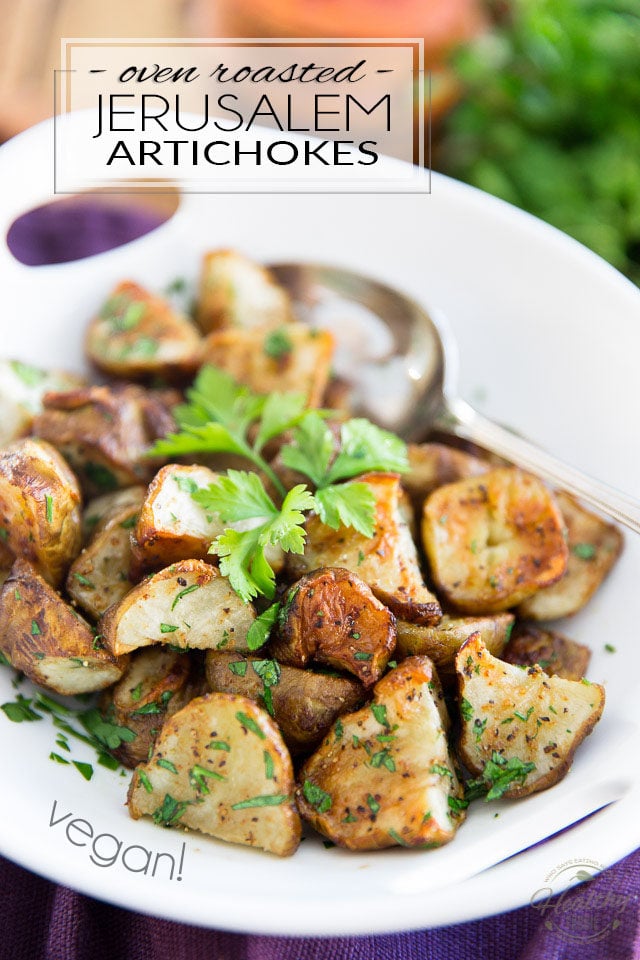
Jerusalem Artichokes, also called Sunchokes or Topinambour, are a nice change from your regular taters! Dare to try them today! (if you can gets your hands on ’em, that is!)
Jerusalem artichokes are very similar to potatoes, except they’re a tad chewier and sweeter and not quite as starchy, with a subtle nutty flavor that’s slightly reminiscent of artichokes, hence, their name…
Although they are called artichokes, they’re actually tubers — and very knobby ones at that! — that sort of look like ginger root, but actually belong to the daisy family. The rhizomes indeed produce the most beautiful yellow flowers in the Fall!
Their season is pretty short, though; they are typically harvested in the late months of the Fall, as it it said that tubers left in the ground past several frosts will be sweeter than those harvested sooner.
And since they do not store as well as potatoes, they’re usually not available for long! If you are lucky enough to stumble upon them at your local market, make sure to grab some! You’ll be happy you did!
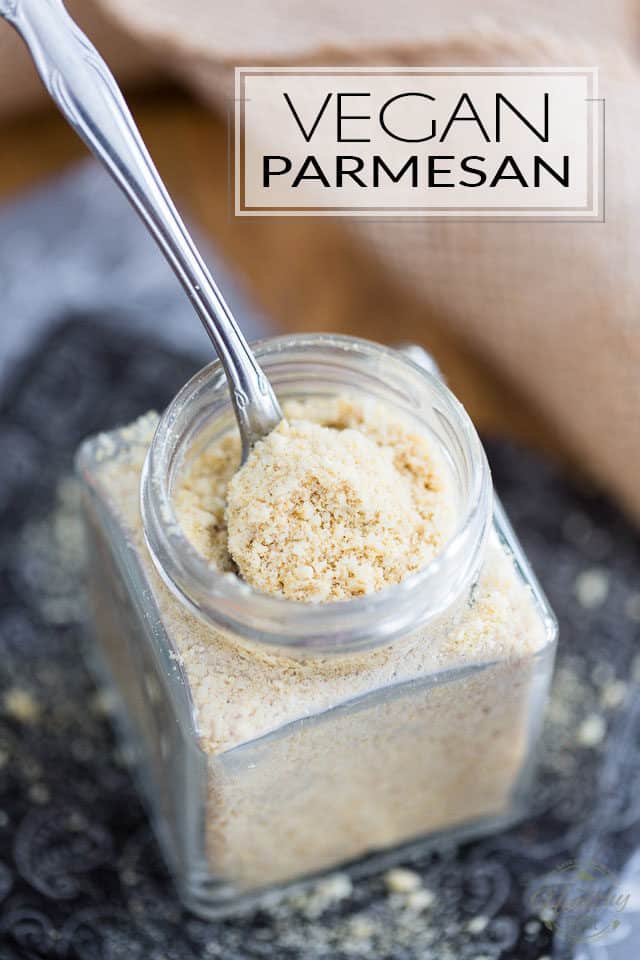
This 5 ingredient Vegan Parmesan only takes 2 minutes to make, and it’s so crazy tasty, you’ll want to sprinkle it on everything! Think “nooch” to the 10th power!
If you’re a vegan, then you probably sprinkle nutritional yeast, aka nooch on just about everything you eat. Well, ok. Maybe not your morning cereal, or your chocolate chia pudding, or anything sweet for that matter. But everything else, you probably be like “hey, pass the nooch this way, please!”I know I do!I put that sh*t on everything!
Sometimes, though, I feel like I want a little bit more… a little bit more texture, a little bit more flavor, a little bit more oomph, you know?! Especially when I’m eating things like pasta with tomato sauce, a fresh crispy leafy salad or a piping hot bowl of minestrone soup, for instance.
That’s when I reach for Vegan Parmesan!
I know there are already plenty of recipes for it on the internet, but I find most are mainly made of cashew meal with just a little bit of nutritional yeast in it. I wanted my vegan parmesan to still offer most of the same nutritional values that nooch has to offer, especially in the vitamin B12 department. So I made sure to incorporate lots of it in my parmesan mix. Also, I added a tiny amount of dried onion flakes, which give the mixture a pleasant yet subtle onion soup flavor, while adding a very agreeable little crunch to it. Personally, I’m a fan! Perhaps too big of a fan, even; I love this stuff so much that I sometimes eat it by the pinchful…
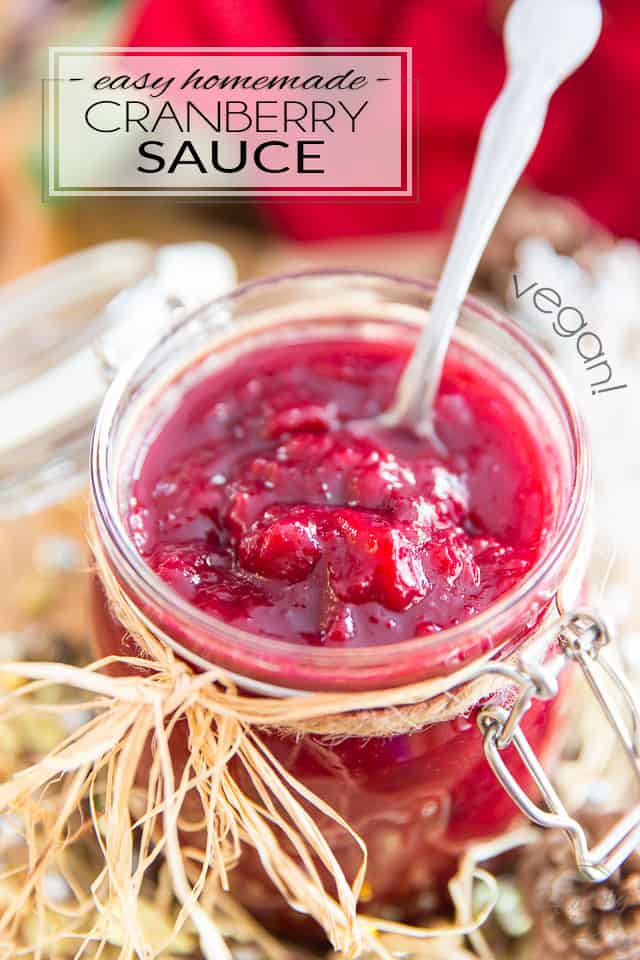
Naturally sweetened with orange juice and maple syrup, this Cranberry Sauce is so stupid easy to make and tastes so much better than the sugar-laden storebought stuff… Plus, it can – and even should – be made ahead of time, so there are no excuses not to make your own!
Cranberry Sauce is a sacrosanct Christmas tradition in this family… Funny thing though is the tradition seems to be me making it, and then completely forgetting to put it on the table on Christmas day! Yeah… that’s actually happened a few times!
But then we eat it for breakfast on toasts in the following weeks. If you’ve never tried that, you really have to! Now I’m not saying that you too should start making cranberry sauce only to forget to serve it to your family and guests on Christmas night, but keep this in mind as the perfect solution when comes time to use any potential leftovers!
This cranberry sauce is totally heavenly, not only on toasts but with your Holiday feast as well… The combination of orange, maple and cranberry, and the nice little touch of vanilla, work so incredibly well together and tastes just like Christmas. Plus, since it isn’t loaded with all kinds of nasty sugars, it isn’t overly sweet but rather retains all the natural tartness and tanginess of the cranberries. All very yummy stuff, really!
So yummy in fact, you might be tempted to make it year ’round.
Health plans should be more willing to pay for high-cost drugs if they actually produce the results patients expect: cures, symptom relief, etc. But pay-for-outcome deals are few and far between.
Abarca Health –a small pharmacy benefit manager (PBM)– recently announced an outcomes-based deal with Amgen for Enbrel. I interviewed Abarca’s chief operating officer, Javier Gonalzez about the announcement.
This is your second deal with Amgen. How did the first one go? What did you learn from it and how did that impact the Enbrel contract?
Abarca is in the process of implementing the outcomes-based agreement with Amgen for Repatha. Because of the innovative and complex nature of these agreements, implementation takes time both with the drug maker and the health plans.
All parties have learned a lot throughout this process, and we expect implementation to get faster with new agreements. We also know that each outcomes-based contract is different. What looks like success for a patient with high cholesterol–like those who take Repatha–might not be the same for someone who is taking Enbrel for rheumatoid arthritis.
The key to a successful outcomes-based contract is collaboration–so this process has allowed Abarca to build a solid working relationship with Amgen. Our organizations are very much aligned in our belief that these agreements have the potential to disrupt the entire healthcare reimbursement system.
The Enbrel arrangement is positioned as an outcomes based contract, but the outcome is just whether the patient stops using the drug. Why not something more advanced, like a clinical measure?
Although our agreement for Enbrel will initially measure discontinuation, we will also be collecting data that drills down further into why the patient stopped treatment–which could be related to side effects, adverse events, or failure to meet therapeutic outcomes.
Though we would like to see additional clinical measures become the determining factors for outcomes-based contracts, it’s important to remember that these agreements are still very much in their infancy. Manufacturers are proceeding very slowly and picking some basic pharmacy therapy outcome endpoints that are reliable and readily accessible—medication adherence and discontinuation, for example—as they build experience.
But, as payers and PBMs build frameworks that can connect disparate patient health data points, and report outcomes through robust analytical platforms, we believe that they will be in a better position to take these agreements to the next level. To help move the industry to this point, Abarca is developing a specialty quality pay-for-performance program to establish clinical, operational, and compliance efficiencies for health plans that will create a game changing experience for patients, pharmacies, and physicians while delivering competitive pricing. We plan to announce this initiative early next year.
What interventions, if any, are utilized to encourage patients to stay on Enbrel? Do you work with any vendors to help?
Our clinical teams work closely with our clients to track adherence across all therapy classes on an ongoing basis. We also have our award-winning Medication Therapy Management (MTM) initiative and programs in place, which look at adherence for high risk patients.
Additionally, we are in the process of ramping up our offerings around the management of specialty patients. Our multi-pronged approach will feature advanced technology, and the eventual development of a quality pay-for-performance program that relies heavily on adherence as a factor to determine success.
I’ve never heard of Abarca. How big are you? Who are your customers?
Abarca was built on the belief that with a smarter technology and a straightforward approach to business, it can provide a better experience and greater value for payers and consumers–and we’ve been delivering on that mission for more than a decade.
As a full-service PBM, Abarca’s clients include self-insured employers, Medicare and commercial plans, and large insurers across the US. We manage more than $2 billion in drug costs for 2.8 million members in commercial, self-insured, Medicare, and Medicaid plans. We also provide Darwin, our advanced technology platform that our team built in-house, to health plans and PBMs.
There have been a lot of companies claiming that they were going to disrupt or revolutionize the PBM industry. Often they use terms like “transparency” to try to differentiate themselves. But they haven’t been very successful. Why would Abarca succeed where others haven’t?
The largest players in the PBM space have found–and maintained–success by adhering to the status quo. Unfortunately, too often those practices favor the company, and not the clients and members they serve. And while some organizations may use the word transparency, we are building relationships with our clients to deliver transparency starting from day one.
For Abarca, transparency means is holding ourselves to a higher standard. It means to be able to look our clients in the eye and tell them “this is exactly what each of your drugs costs and why.” We don’t believe that transparency should be touted as a differentiator, it should be the industry standard.
Our company was founded to throw out the PBM playbook and find a better way in healthcare–and we have structured every aspect of our business in pursuit of that mission.
We have built industry-leading technology from scratch that makes PBM processes integrated, user-friendly, and modern–and has attracted the attention of some of the nation’s leading PBMs. Within a two year period, we will have doubled the size of our team to accommodate our ongoing growth. And, while many PBMs are in the process of debating outcomes based contracts, we’re executing them with some of the nation’s leading pharmaceutical manufacturers.
What other kinds of outcomes based contracts do you have in the pipeline? What kinds of drugs are good candidates?
Abarca will be focusing on high-cost, high-risk specialty medications for our future outcomes-based contracts. Specifically, we’re looking at treatments for multiple sclerosis, rheumatoid arthritis, hypercholesteremia, and breast cancer, among other disease states.
Do pharma companies want to do more of these deals? Why?
The adoption of innovative drug contracts has been slow and steady over the last few years. In fact, a recent report by PhRMA found that the list of publicly announced value-based contracts grew from 39% to 43% during 2018. But, there are several important trends that are emerging that could change healthcare significantly, including pay-for-performance, calls for transparency, and, potentially, moves away from existing rebate models.
Based on these factors, I believe that pharmaceutical companies are increasingly warming to these types of agreements. There is also the added bonus that outcomes-based agreements give drug makers critical, real-world insight into the performance of their products.
In general, pharmacy can be a very slow moving industry. But, those who are willing to innovate on their own accord–rather than industry mandate–will be in a better position for long-term success.
How about payers? What is their motivation?
Payers are really looking forward to the widespread adoption of these agreements, for a few reasons. First, it puts more accountability on manufacturers for the performance of their products. Additionally, it will help to facilitate better fact-based formulary decisions.
Today, there are a number of factors that contribute to whether or not a drug appears on a formulary but, in many cases, the process can be quite opaque. That’s not how important decisions that impact member health should be made. As outcomes-based agreements become commonplace, we will have the data necessary to manage formularies with more transparency, and objectivity. Specifically, the total impact of cost will be easier to manage and decisions can be made based on clinical outcomes, rather than pharmacy-based data points.
Do you expect these outcomes based plans to be emulated by other PBMs? Does Abarca provide technology to other PBMs that will help?
We would hope that these types of agreements become the standard in our market. However, we recognize that not every PBM has the technology necessary to support them.
Along with being a full-service PBM, Abarca provides the technology, analytics, and reporting capabilities for health plans and PBMs to support innovative drug contracting–and other clinical initiatives. It may seem a little counterintuitive to provide what some see as our “secret sauce” to the competition, but we believe that health plans, pharmacists, physicians, and, most importantly, patients deserve a better experience–no matter who their PBM is.